
 English
 Français
 日本語
 العربية
 繁体中文
 简体中文


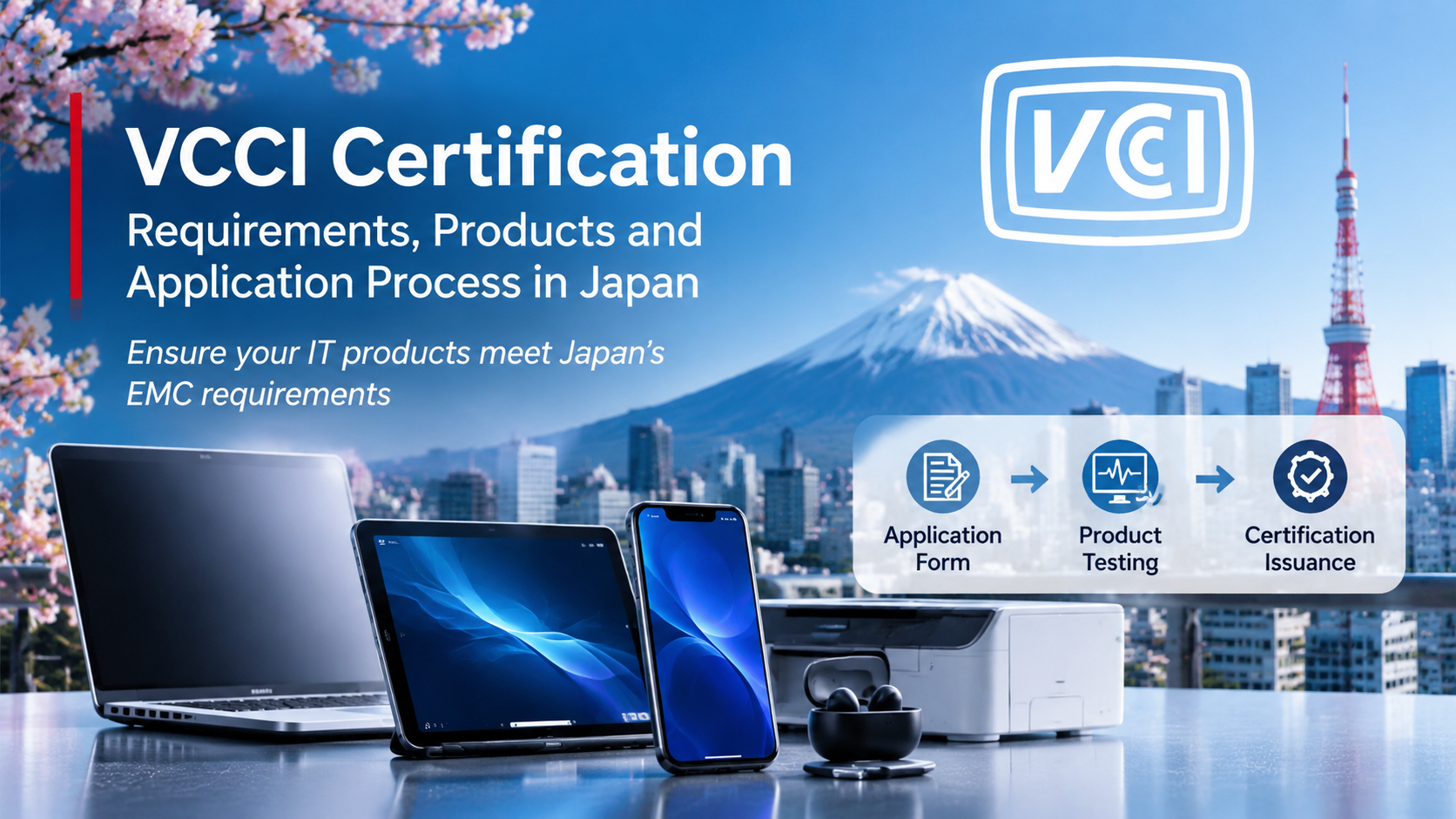
What Is VCCI Compliance in Japan? Product Scope and Application Process
1. What Is VCCI?
VCCI stands for the Voluntary Control Council for Interference by Information Technology Equipment. It is a Japanese industry organization that promotes the voluntary control of electromagnetic disturbances generated by information technology and multimedia equipment.
The VCCI scheme is designed to help ensure that equipment does not cause excessive electromagnetic interference (EMI) to other electronic devices. Its technical requirements are based on the CISPR standards, with VCCI-CISPR 32 serving as the key emissions standard for multimedia equipment.
Unlike a statutory certification scheme, VCCI is a voluntary industry framework in Japan. The VCCI mark is not a government-issued certification mark. Instead, it indicates that the equipment has been verified as meeting the applicable VCCI emission requirements.
Although participation is not legally mandatory, VCCI conformity is widely adopted by manufacturers placing relevant products on the Japanese market.
Manufacturers wishing to place products on the market with the VCCI mark must first become VCCI members. Conformity testing must be conducted using measurement facilities registered with the VCCI Council, and the conformity results must be submitted through the Council's registration procedure.
2. Products Covered by the VCCI Scheme
The VCCI scheme applies to relevant multimedia equipment (MME). Examples of product categories may include:
Computers and servers: Mainframe computers, supercomputers, servers, desktop computers, laptops, handheld computers, workstations and microcomputers.
Office equipment: Copiers, word processors and other office information-processing equipment.
Peripheral equipment: Storage devices, printers, LCD and CRT monitors, input/output devices, general-purpose terminals and specialized terminals such as POS systems.
Telecommunications and network equipment: Fax machines, PBX systems, telephones, modems, digital transmission equipment, terminal adapters, hubs, repeaters, switches and routers.
Other electronic equipment: Certain digital cameras, navigation devices, toys and digital audio players, where they fall within the applicable VCCI equipment scope.
The applicable requirements depend on the equipment's classification and intended operating environment. Products should therefore be checked against the VCCI scope and technical requirements before testing.
3. VCCI Application and Conformity Assessment Process
The general process for demonstrating VCCI conformity involves the following steps:
Step 1: VCCI Membership
The manufacturer or responsible company must become a VCCI member before submitting product conformity information and using the VCCI mark.
Step 2: Sample and Technical Documentation Preparation
Prepare representative product samples and relevant technical information for testing. The documentation may include product specifications, user manuals, technical descriptions and other information required by the testing facility.
Step 3: EMI Conformity Testing
The product is tested against the applicable VCCI technical requirements, generally based on VCCI-CISPR 32. Testing must be performed using measurement facilities registered with the VCCI Council.
Step 4: Product Conformity Registration and Marking
After confirming that the product meets the applicable requirements, the VCCI member submits a conformity verification report through the VCCI registration system. Once the Council issues an acceptance notification, the member may ship the registered product with the prescribed VCCI marking and wording, as applicable.
4. Key Points for Manufacturers
Before planning VCCI conformity activities, manufacturers should pay attention to the following:
Membership is required to use the VCCI mark: Companies must complete the relevant VCCI membership procedure.
Use an appropriately registered test facility: Testing must follow the applicable VCCI technical requirements and use measurement facilities registered with the Council.
Confirm the correct equipment classification: The applicable limits and marking requirements depend on the product category and its intended environment.
Complete conformity registration: A passing test report alone does not replace the required submission and acceptance procedure.
For manufacturers planning to introduce information technology or multimedia equipment to Japan, identifying the applicable VCCI requirements early can help reduce compliance risks and avoid delays in market entry.
Blue Asia provides EMC testing and global market access support for electronic and wireless products. Contact our team to discuss your product's testing and compliance requirements.
Email:[email protected] (Olivia)
Whatsapp:+8617663606879
 Blog
Android Auto Testing Standards and Test Items
Leer artículo
 Blog
CarPlay Testing Standards and Test Items
Leer artículo
 Blog
EU eCall Type Approval: How Long Is It Valid, and When Does It Need to Be Updated?
Leer artículo
 Blog
What Is VCCI Compliance in Japan? Product Scope and Application Process
Leer artículo
 Blog
Canada ISED Certification: Application Process, Standards and Documentation
Leer artículo
 Blog
Does the 2026 DAB+ Standard Update Mean You Need to Retest Your Products?
Leer artículo

 4000259520