
 English
 Français
 日本語
 العربية
 繁体中文
 简体中文


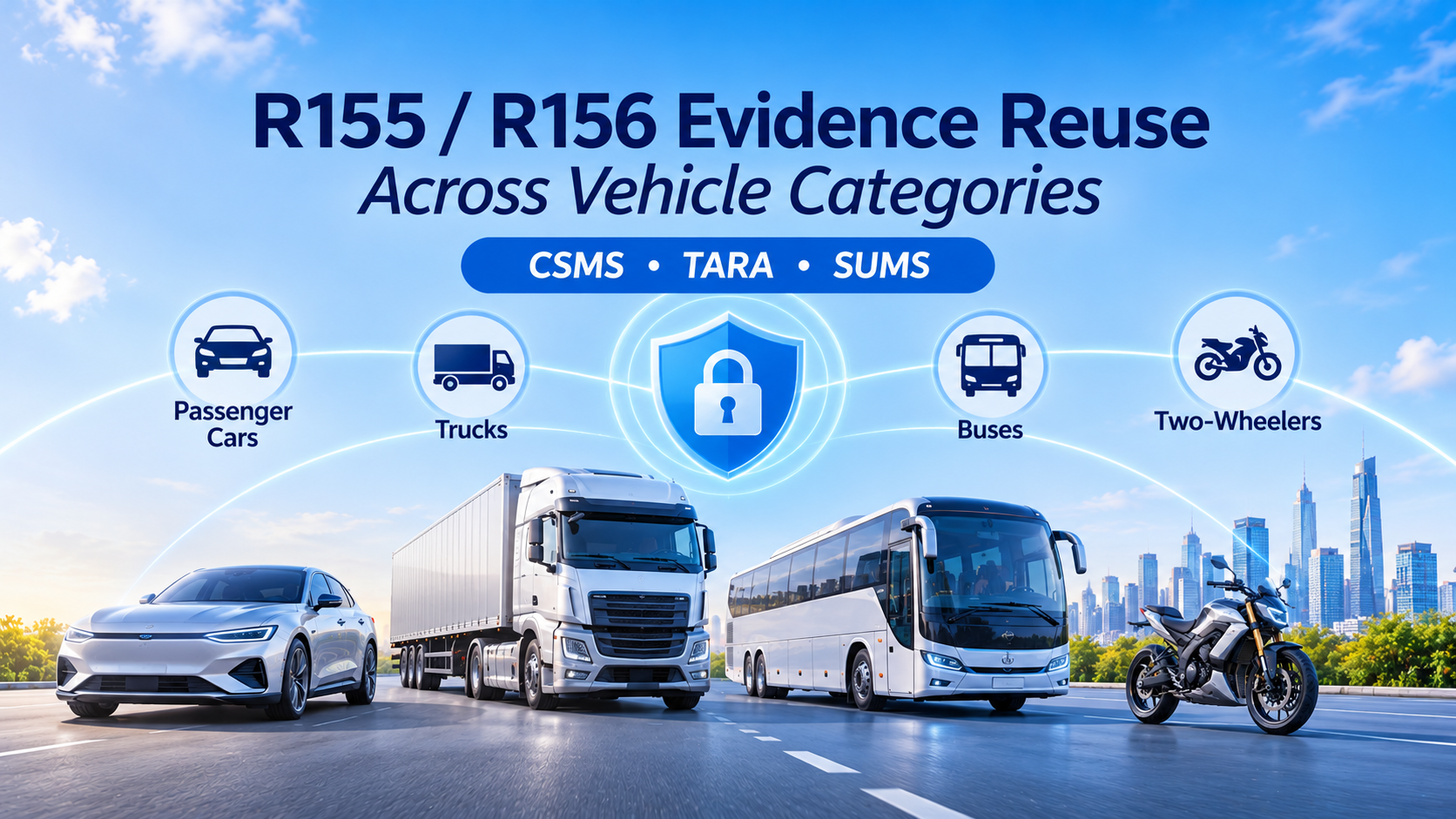
Can R155/R156 Evidence Be Reused Across Vehicle Categories?
Can R155/R156 Evidence Be Reused Across Vehicle Categories?
Your passenger-car cybersecurity evidence is complete. Can you simply reuse it for a truck—or an electric motorcycle?
The short answer is:
Some evidence can be reused. The vehicle-level conclusion cannot simply be copied.
This distinction is becoming increasingly important for suppliers supporting multiple vehicle platforms.
A supplier may already have a mature CSMS, TARA methodology, cybersecurity requirements, supplier controls and SUMS evidence from a passenger-car programme. When the same product is introduced into trucks, buses or L-category vehicles, the existing evidence can provide a valuable foundation.
But the new vehicle architecture, interfaces, threat exposure, software configuration and type-approval scope can change the cybersecurity assessment.
For suppliers, the goal should therefore be:
Reuse the methodology and stable evidence—reassess what is vehicle-dependent.
1. R155 Is Not a “One Certificate Fits All” System
UN Regulation No. 155 establishes requirements concerning vehicle cybersecurity and the Cyber Security Management System (CSMS).
The regulation is based on a risk-based approach, with the vehicle manufacturer responsible for demonstrating that cybersecurity risks are appropriately managed.
This creates an important distinction for suppliers.
A supplier's previous R155-related evidence may demonstrate:
Cybersecurity processes
Risk-management methodology
Vulnerability management
Incident response
Secure development processes
Supplier management
Security testing methodology
These elements can often be reused.
However, a TARA performed for Vehicle A is not automatically a valid TARA for Vehicle B.
Why?
Because the attack surface can change.
2. What Can Usually Be Reused?
A useful way to classify evidence is into three levels.
Level 1 — Highly Reusable
These are process-oriented or organisational evidence.
Examples include:
CSMS procedures
Cybersecurity governance
Risk-management methodology
Vulnerability-management process
Incident-response procedure
Supplier cybersecurity management
Secure development lifecycle
If the supplier organisation and process have not materially changed, these documents may provide a strong reusable foundation across vehicle programmes.
The exact acceptance still depends on the OEM and type-approval context.
Level 2 — Reusable With a Gap Assessment
This includes technical security evidence related to a product or ECU.
Examples:
Security architecture
Threat analysis methodology
Secure boot
Authentication
Diagnostic security
Communication protection
Software update mechanisms
Penetration-test results
The evidence may remain technically relevant—but the supplier must check whether the new vehicle integration changes the assumptions behind the original assessment.
Level 3 — Vehicle-Specific
This is where direct reuse becomes dangerous.
Examples include:
Vehicle-level TARA
Vehicle attack paths
ECU interfaces
CAN/Ethernet architecture
Gateway relationships
External connectivity
Vehicle-specific threat scenarios
Risk classification
Vehicle-level cybersecurity goals
These normally need to be reassessed for the new vehicle platform.
3. The Same ECU Can Have a Different Risk Profile
Consider a telematics ECU used in three platforms.
Passenger car
The ECU communicates with:
Cellular + GNSS + CAN + cloud
Heavy truck
The same ECU now communicates with:
Cellular + GNSS + CAN + Ethernet + fleet-management systems + trailer interfaces
Electric motorcycle
The ECU may communicate with:
Cellular + Bluetooth + smartphone app + CAN + BMS + motor controller
The hardware may be almost identical.
The cybersecurity context is not.
The attack surface changes with the interfaces, vehicle architecture and operational functions.
Therefore:
Same ECU ≠ same TARA.
The previous passenger-car TARA should be treated as a starting point—not the final cybersecurity conclusion.
4. TARA Is Where Most Cross-Platform Reuse Breaks Down
A TARA depends on the assets, entry points, threats, attack paths, impacts and risk assumptions being assessed.
When the vehicle changes, several of these inputs can change.
For example, a passenger-car infotainment ECU may have limited access to safety-critical functions.
In a truck platform, the same ECU could have additional communication paths into fleet-management or vehicle-control networks.
In a connected motorcycle, it may have a direct relationship with the BMS, motor controller or smartphone application.
The supplier therefore needs to ask:
Did the vehicle integration change the attack surface or the potential impact?
If yes, the original TARA cannot simply be copied.
Instead, the supplier should perform a TARA delta assessment.
Compare:
Original architecture
vs.
New vehicle architecture
Then identify:
New interfaces
Removed interfaces
Changed trust boundaries
New external connections
New assets
Changed attack paths
Changed cybersecurity goals
Changed risk ratings
This is often much more efficient than starting the entire analysis from zero.
5. What About CSMS Evidence?
CSMS evidence is generally more reusable than vehicle-level TARA evidence.
For example, a supplier that has already established:
Cybersecurity policy
Roles and responsibilities
Risk-management procedures
Secure development lifecycle
Vulnerability monitoring
Incident response
Supplier controls
Security update processes
does not need to rebuild these processes simply because the ECU is entering a different vehicle category.
However, the OEM's CSMS and supplier interface still matter.
UNECE discussions on multistage vehicles increasingly focus on how cybersecurity responsibilities and evidence should be shared between the original vehicle manufacturer and other parties.
For suppliers, this means a reusable CSMS package should clearly identify:
What is supplier-owned?
What is vehicle-OEM-owned?
What evidence depends on vehicle integration?
This separation makes future projects much easier.
6. R156 Evidence Has a Different Reuse Boundary
UN Regulation No. 156 focuses on Software Update Management Systems (SUMS) and software-update processes.
The same principle applies:
The SUMS process can be reusable; the vehicle software-update impact cannot always be copied.
For example, a supplier may already have:
Software version control
Release approval
Update integrity mechanisms
Update traceability
Rollback/recovery procedures
Compatibility assessment
Change management
Software identification processes
These can form a reusable evidence base.
But when the software is installed on a different vehicle platform, the supplier should reassess:
Which ECUs are affected
Which vehicle functions may change
Whether the update affects cybersecurity
Whether compatibility changes
Whether a new vehicle type or approval impact exists
UNECE materials specifically note that software versions of relevant ECUs—such as telematics, infotainment and HMI systems—can affect the definition of a vehicle type for R156 purposes.
So again:
SUMS process reuse ≠ automatic R156 vehicle evidence reuse.
7. Trucks and Motorcycles Are Not Just “New Body Styles”
Cross-platform migration becomes even more important as R155 expands.
UNECE decided to extend R155 to motorcycles, scooters and certain electric bicycles above 25 km/h, reflecting the increasing cybersecurity exposure of connected L-category vehicles.
The EU implementation roadmap makes this particularly relevant for manufacturers.
For L-category vehicles, new vehicle types are subject to the EU R155 requirements from 11 December 2027, with existing vehicle types following from 11 June 2029.
This creates a practical opportunity for suppliers.
If your company already supplies cybersecurity-controlled ECUs to passenger cars, now is the time to examine which parts of your existing evidence can support:
Truck → Motorcycle → Connected L-category
rather than waiting for each project to start from zero.
8. A Practical Evidence Reuse Matrix
For suppliers, the following approach is more realistic than “reuse everything” or “redo everything.”
| Evidence | Cross-Platform Reuse | Typical Action |
|---|---|---|
| CSMS procedures | High | Reuse + confirm scope |
| Secure development process | High | Reuse + gap check |
| Vulnerability management | High | Reuse + confirm lifecycle |
| Supplier cybersecurity process | High | Reuse + OEM interface review |
| Security architecture | Medium | Review assumptions |
| Penetration testing | Medium | Check environment and scope |
| Product-level TARA | Medium | Perform delta assessment |
| Vehicle-level TARA | Low | Reassess for new platform |
| Vehicle attack paths | Low | Rebuild/validate |
| Software update process | High | Reuse SUMS process |
| Vehicle update impact | Low/Medium | Reassess per vehicle |
The objective is not to maximise reuse.
It is to reuse what is genuinely stable and reassess what depends on vehicle context.
9. What Suppliers Should Prepare Now
If your company supplies the same ECU or software platform to multiple vehicle manufacturers, build a Reusable Cybersecurity Evidence Package.
Separate it into four folders:
A. Corporate Evidence
CSMS, policies, roles, training and governance.
B. Product Evidence
Security architecture, secure boot, authentication, diagnostics, communication protection and vulnerability management.
C. Reusable TARA Assets
Common assets, threats, attack patterns, security goals and reusable assumptions.
D. Vehicle-Specific Evidence
Vehicle interfaces, network architecture, attack paths, impact analysis and final risk assessment.
This structure can dramatically reduce duplicated work while keeping the regulatory boundary clear.
The Supplier Strategy Should Be “Reuse + Reassess”
The wrong strategy is:
Passenger Car R155 Package → Copy → Truck → Copy → Motorcycle
The better strategy is:
Existing Evidence → Applicability Review → TARA Delta → Vehicle Integration Assessment → Updated Evidence Package
For suppliers, this approach provides two advantages:
Less duplicated engineering work
and
Better traceability when OEMs or technical services ask why existing cybersecurity evidence is still valid.
At BlueAsia Labs, we support connected automotive and mobility products with compliance assessments spanning RF, EMC, wireless connectivity, IoT, vehicle electronics and automotive cybersecurity-related requirements.
For suppliers moving the same connected ECU or software platform across passenger cars, trucks, buses or L-category vehicles, we can help map which existing technical evidence can be reused, where a TARA delta is needed, and where vehicle-specific validation remains necessary.
The most valuable cybersecurity evidence is not the document you reuse the most. It is the evidence whose assumptions remain valid when the vehicle changes.
 Blog
Why Smart Cockpit Projects Fail Because Of System Integration—Not Hardware
Leer artículo
 Blog
Why Passing Android Auto Doesn't Mean Your Connectivity System Is Ready
Leer artículo
 Blog
Can R155/R156 Evidence Be Reused Across Vehicle Categories?
Leer artículo
 Blog
GSO 2693:2026 Is Now Here. Does Your Existing DAB+ Test Report Still Cover the New GCC Requi
Leer artículo
 Blog
Why Software Updates Are Creating Supplier Management Challenges
Leer artículo
 Blog
Why Certification Engineers Need to Think Like System Architects
Leer artículo

 4000259520